
MCAT Scores & Percentile Rankings — Your Complete Guide
Everything you need to know about the MCAT scoring system — from how scores are calculated and what percentiles mean to setting the right target for your medical school goals.
How MCAT Scores Work
The MCAT uses a unique scoring scale that differs from most standardized tests. Understanding how AAMC scores work is essential for setting meaningful goals and interpreting your results.
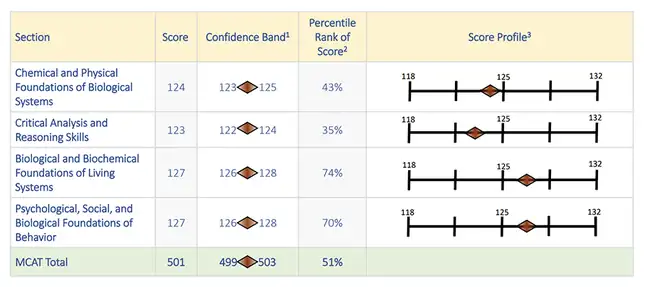
The MCAT is divided into four scored sections: Chemical and Physical Foundations of Biological Systems (Chem/Phys), Critical Analysis and Reasoning Skills (CARS), Biological and Biochemical Foundations of Living Systems (Bio/Biochem), and Psychological, Social, and Biological Foundations of Behavior (Psych/Soc). Each section receives a scaled score between 118 and 132, with 125 as the section midpoint.
Your total MCAT score is simply the sum of all four section scores, producing a range of 472 to 528. The overall midpoint is 500, which was designed to represent approximately the 50th percentile — meaning a 500 indicates performance equal to or better than roughly half of all examinees.
Key detail: The AAMC converts your raw score (number of correct answers) into a scaled score through a statistical process called equating. This adjustment ensures that scores remain comparable across different test administrations, regardless of minor difficulty variations between exam forms.
MCAT Scores and Percentiles
Your MCAT score percentile tells you what proportion of test-takers scored at or below your level. The MCAT score percentiles chart below maps common total score ranges to their approximate MCAT percentile rankings and competitiveness for medical school admissions.
| Total Score | Approximate Percentile | Competitiveness |
|---|---|---|
| 524–528 | 99th–100th | Elite — competitive for the most selective research institutions |
| 519–523 | 96th–99th | Exceptional — strong candidate for top-20 medical schools |
| 515–518 | 90th–95th | Very strong — competitive at highly ranked programs nationwide |
| 511–514 | 80th–89th | Strong — competitive for the majority of MD programs |
| 508–510 | 72nd–79th | Above average — meets the threshold at many allopathic schools |
| 504–507 | 60th–71st | Average — competitive for DO programs and select MD schools |
| 500–503 | 49th–59th | Below median — may limit MD options; solid for many DO programs |
| Below 500 | Below 49th | Below average — significant improvement typically needed |
Note: Percentile rankings are recalculated by the AAMC each year using the most recent three testing years of data. The figures above are approximate. Always check the official AAMC percentile tables for the latest numbers.
What Is a Good MCAT Score?
There is no single answer — the right target depends on the programs you are applying to. These three benchmarks cover the most common scenarios.
508+ for Most MD Schools
Scoring 508 or above puts you above the 72nd percentile and at or above the median for accepted students at many allopathic medical schools. If you are applying broadly to MD programs, this is a solid baseline target. For osteopathic (DO) schools, scores around 504 to 506 are typically competitive.
515+ for Top Programs
Students targeting top-20 medical schools or ultra-competitive specialties should aim for 515 or higher, placing them at or above the 90th percentile. At these institutions, the average matriculant score often falls between 517 and 522, so every additional point strengthens your candidacy.
Balanced Section Scores Matter
Medical school admissions committees evaluate each section individually, not just the composite total. A 514 with four consistent sections at 128 or 129 is generally viewed more favorably than a 514 with one section at 132 and another at 124. Even score distribution signals thorough preparation.
How MCAT Scores Are Reported
Knowing what to expect after test day — from the waiting period to what appears on your official record — helps you plan your application timeline with confidence.
Score Release Timeline
MCAT scores are released approximately 30 to 35 days after your exam date. Results go live at 5:00 PM Eastern Time on the scheduled release date. The AAMC publishes the specific release date for each test administration at the start of the testing cycle, so you will know exactly when to expect your results. You will receive an email notification and can view your report through your AAMC account.
What the Report Includes
Your official MCAT score report contains your scaled score (118 to 132) and percentile rank for each of the four sections, along with your total scaled score and overall percentile rank. The report also includes confidence bands — statistical ranges that account for measurement variability. When you submit your scores through AMCAS, medical schools receive the same detailed breakdown.
Void vs. Score Decision
Immediately after completing the MCAT, you must decide whether to void or score your exam. Voiding means no score is recorded and schools never see the attempt, though it still counts toward your lifetime testing limits. If your test-day performance fell well below your practice averages, voiding can be a strategic choice to protect your application record.
How to Improve Your MCAT Score
Whether you are preparing for your first attempt or planning a focused retake, these four principles consistently produce the largest score gains.
Start with a Diagnostic Analysis
A full-length diagnostic exam reveals far more than a single number. The real insight comes from categorizing every missed question by root cause — was it a content gap, a misread passage, a timing issue, or flawed reasoning? Each type of error demands a different corrective strategy, and identifying the pattern up front prevents wasted study hours.
Target Your Weakest Areas First
It is natural to gravitate toward topics you already understand, but the greatest point gains come from deliberate practice on your weakest content areas and question types. Spending two hours on amino acid metabolism when it is a genuine gap will raise your score more than two hours reinforcing organic chemistry you have already mastered.
Review Every Practice Question
The most effective MCAT study habit is thorough review of every practice question — including the ones you answered correctly. Understanding why each answer choice is right or wrong, and how the passage supports the correct answer, builds the deep analytical thinking the exam rewards. Simply doing more questions without reviewing them yields diminishing returns.
Work with an Expert Tutor
A skilled MCAT tutor accelerates improvement by identifying blind spots you cannot see on your own, teaching passage-based strategies that textbooks do not cover, and holding you accountable to a structured study schedule. Dr. Donnelly's students typically improve their composite score by 10 to 15 points through targeted private tutoring sessions.
MCAT Scores & Percentiles — FAQs
The MCAT total score ranges from 472 to 528. Each of the four sections — Chem/Phys, CARS, Bio/Biochem, and Psych/Soc — is scored from 118 to 132. The midpoint of the total scale is 500, which corresponds to roughly the 50th percentile of all test-takers. There is no penalty for wrong answers, so your raw score is based solely on the number of correct responses.
For most allopathic (MD) programs, a total score of 508 or higher is competitive — this places you above the 72nd percentile. If your goal is a top-20 school, aim for 515 or above (90th percentile or higher). Osteopathic (DO) programs are typically competitive at 504 to 506. Remember that your MCAT score is evaluated alongside your GPA, extracurriculars, and personal statement.
MCAT percentile rankings reflect the percentage of test-takers who scored at or below a given score. The AAMC recalculates these rankings each year using data from the three most recent testing years. Because the testing population changes slightly from year to year, percentile values can shift — a score that was the 85th percentile one year might be the 84th or 86th the next. Always refer to the current AAMC percentile tables for precise figures.
MCAT scores are released approximately 30 to 35 days after your test date. Results become available at 5:00 PM Eastern Time on the scheduled release date. You will receive an email notification from the AAMC, and your full score report — including section scores, total score, percentiles, and confidence bands — will be accessible through your AAMC account. See our MCAT test dates page for a complete 2026 score release schedule.
The average MCAT score across all test-takers is approximately 500, which falls at the 50th percentile. However, the average score among students who actually matriculate into MD programs is considerably higher — around 511 to 512. This gap highlights the importance of aiming above the overall average if you intend to apply to allopathic medical schools.
Absolutely. An experienced MCAT tutor pinpoints the specific content gaps, reasoning weaknesses, and timing habits that are holding your score back — issues that are difficult to diagnose on your own. Dr. Donnelly builds a personalized study plan around your diagnostic results and adjusts it as you improve. His students typically gain 10 to 15 points on their total score. Learn more about MCAT tutoring or book a free consultation to get started.